Back

Nidra yoga practice
Nidra yoga practice
Nidra yoga is a powerful yogic technique that allows one to achieve deep physical and mental relaxation, calms the mind, and promotes inner peace.
Yoga Nidra Practice
It is important for each of us to know how to relax, so we are constantly looking for the best ways to do it. At Mai Ram Yoga School, we apply a powerful yoga relaxation technique – Yoga Nidra. Yoga Nidra practice is considered a practice of conscious rest; it is a state between sleep and wakefulness where the body rests while the mind remains alert. This practice has a positive effect on a person's physical, emotional, and spiritual state.
Yoga Nidra Practice
It is important for each of us to know how to relax, so we are constantly looking for the best ways to do it. At Mai Ram Yoga School, we apply a powerful yoga relaxation technique – Yoga Nidra. Yoga Nidra practice is considered a practice of conscious rest; it is a state between sleep and wakefulness where the body rests while the mind remains alert. This practice has a positive effect on a person's physical, emotional, and spiritual state.
Yoga Nidra Practice
It is important for each of us to know how to relax, so we are constantly looking for the best ways to do it. At Mai Ram Yoga School, we apply a powerful yoga relaxation technique – Yoga Nidra. Yoga Nidra practice is considered a practice of conscious rest; it is a state between sleep and wakefulness where the body rests while the mind remains alert. This practice has a positive effect on a person's physical, emotional, and spiritual state.
What is Yoga Nidra?
Yoga Nidra is "yogic sleep" or a conscious practice of deep relaxation, during which a state of consciousness between wakefulness and sleep is achieved. It is not an active physical yoga practice with performed poses (asanas). Yoga Nidra is geared towards deep inner relaxation. It is a powerful yogic technique that allows one to achieve deep physical and mental relaxation, calms the mind, and promotes inner peace.
What is Yoga Nidra?
Yoga Nidra is "yogic sleep" or a conscious practice of deep relaxation, during which a state of consciousness between wakefulness and sleep is achieved. It is not an active physical yoga practice with performed poses (asanas). Yoga Nidra is geared towards deep inner relaxation. It is a powerful yogic technique that allows one to achieve deep physical and mental relaxation, calms the mind, and promotes inner peace.
What is Yoga Nidra?
Yoga Nidra is "yogic sleep" or a conscious practice of deep relaxation, during which a state of consciousness between wakefulness and sleep is achieved. It is not an active physical yoga practice with performed poses (asanas). Yoga Nidra is geared towards deep inner relaxation. It is a powerful yogic technique that allows one to achieve deep physical and mental relaxation, calms the mind, and promotes inner peace.
How does Yoga Nidra practice take place?
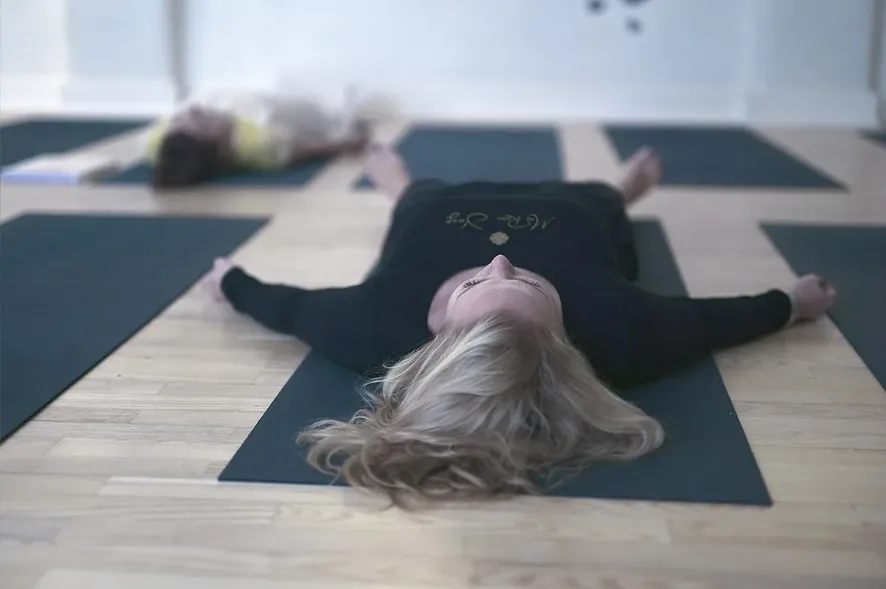
Yoga Nidra is practiced lying down in complete relaxation, in the Savasana pose on the floor, following the guidance of a yoga teacher. The yoga teacher names parts of the body, encouraging the person to relax each one of them, guides the focus of attention to the breath, and conducts visualization. During Yoga Nidra, a person relaxes, but they must not lose consciousness or fall asleep. Their body becomes relaxed like it is sleeping, while the mind remains alert. The practice lasts 1 hour.
How does Yoga Nidra practice take place?
Yoga Nidra is practiced lying down in complete relaxation, in the Savasana pose on the floor, following the guidance of a yoga teacher. The yoga teacher names parts of the body, encouraging the person to relax each one of them, guides the focus of attention to the breath, and conducts visualization. During Yoga Nidra, a person relaxes, but they must not lose consciousness or fall asleep. Their body becomes relaxed like it is sleeping, while the mind remains alert. The practice lasts 1 hour.
How does Yoga Nidra practice take place?
Yoga Nidra is practiced lying down in complete relaxation, in the Savasana pose on the floor, following the guidance of a yoga teacher. The yoga teacher names parts of the body, encouraging the person to relax each one of them, guides the focus of attention to the breath, and conducts visualization. During Yoga Nidra, a person relaxes, but they must not lose consciousness or fall asleep. Their body becomes relaxed like it is sleeping, while the mind remains alert. The practice lasts 1 hour.
Preparation for Yoga Nidra Practice
To experience all the benefits provided by Yoga Nidra, it is important to prepare properly for the practice. A few key tips for proper practice preparation:
Quiet environment.
Practicing Yoga Nidra in an ashram can help you focus better on the practice, dive deeper into a state of relaxation, and feel inner peace and security. If Yoga Nidra is practiced at home, it is important to ensure there is as little noise and distraction around as possible. Artificial lights should be dimmed or turned off completely.Lie down comfortably on your back.
Yoga Nidra is practiced lying on your back, so during the practice, you lie down on a yoga mat. To stay warmer and slightly softer, you can lay a blanket under you.Maintain body warmth.
The body cools down when relaxed, so it is recommended to cover yourself with a blanket to stay warm and cozy throughout the practice.Do not go to practice on a full stomach.
To feel light and comfortable, it is advisable to avoid heavy and large meals for at least 1.5–2 hours before practice.Do not participate in group practices if you are sick.
If you feel symptoms of a cold, nausea, or other ailments, we advise you to choose rest at home, and try Yoga Nidra once you have recovered. You can also practice individually at home by listening to Yoga Nidra recordings from the Mai Ram Yoga Patreon platform.
Preparation for Yoga Nidra Practice
To experience all the benefits provided by Yoga Nidra, it is important to prepare properly for the practice. A few key tips for proper practice preparation:
Quiet environment.
Practicing Yoga Nidra in an ashram can help you focus better on the practice, dive deeper into a state of relaxation, and feel inner peace and security. If Yoga Nidra is practiced at home, it is important to ensure there is as little noise and distraction around as possible. Artificial lights should be dimmed or turned off completely.Lie down comfortably on your back.
Yoga Nidra is practiced lying on your back, so during the practice, you lie down on a yoga mat. To stay warmer and slightly softer, you can lay a blanket under you.Maintain body warmth.
The body cools down when relaxed, so it is recommended to cover yourself with a blanket to stay warm and cozy throughout the practice.Do not go to practice on a full stomach.
To feel light and comfortable, it is advisable to avoid heavy and large meals for at least 1.5–2 hours before practice.Do not participate in group practices if you are sick.
If you feel symptoms of a cold, nausea, or other ailments, we advise you to choose rest at home, and try Yoga Nidra once you have recovered. You can also practice individually at home by listening to Yoga Nidra recordings from the Mai Ram Yoga Patreon platform.
Preparation for Yoga Nidra Practice
To experience all the benefits provided by Yoga Nidra, it is important to prepare properly for the practice. A few key tips for proper practice preparation:
Quiet environment.
Practicing Yoga Nidra in an ashram can help you focus better on the practice, dive deeper into a state of relaxation, and feel inner peace and security. If Yoga Nidra is practiced at home, it is important to ensure there is as little noise and distraction around as possible. Artificial lights should be dimmed or turned off completely.Lie down comfortably on your back.
Yoga Nidra is practiced lying on your back, so during the practice, you lie down on a yoga mat. To stay warmer and slightly softer, you can lay a blanket under you.Maintain body warmth.
The body cools down when relaxed, so it is recommended to cover yourself with a blanket to stay warm and cozy throughout the practice.Do not go to practice on a full stomach.
To feel light and comfortable, it is advisable to avoid heavy and large meals for at least 1.5–2 hours before practice.Do not participate in group practices if you are sick.
If you feel symptoms of a cold, nausea, or other ailments, we advise you to choose rest at home, and try Yoga Nidra once you have recovered. You can also practice individually at home by listening to Yoga Nidra recordings from the Mai Ram Yoga Patreon platform.
The Course of the Practice
After lying down in Savasana pose and closing your eyes, preparation begins for withdrawing the senses from external objects. Then, a few deep breaths are taken so that the person calms the mind and completely relaxes the body. Next, a Sankalpa is formed, which is a short inner promise to oneself with the aim of getting rid of vices or relaxing and calming down. Then, the teacher directs the person's attention to various parts of the body, helping them to relax and calm the nervous system. The breathing is also observed. Next, the teacher selects certain imagery for visualization, which promotes deep relaxation of the mind and creativity. In the end, there is a return to repeating the Sankalpa so that the intention sinks deeper into the subconscious mind. Gradually, attention is brought back to the external environment, body parts are moved, and eyes are opened.
The Course of the Practice
After lying down in Savasana pose and closing your eyes, preparation begins for withdrawing the senses from external objects. Then, a few deep breaths are taken so that the person calms the mind and completely relaxes the body. Next, a Sankalpa is formed, which is a short inner promise to oneself with the aim of getting rid of vices or relaxing and calming down. Then, the teacher directs the person's attention to various parts of the body, helping them to relax and calm the nervous system. The breathing is also observed. Next, the teacher selects certain imagery for visualization, which promotes deep relaxation of the mind and creativity. In the end, there is a return to repeating the Sankalpa so that the intention sinks deeper into the subconscious mind. Gradually, attention is brought back to the external environment, body parts are moved, and eyes are opened.
The Course of the Practice
After lying down in Savasana pose and closing your eyes, preparation begins for withdrawing the senses from external objects. Then, a few deep breaths are taken so that the person calms the mind and completely relaxes the body. Next, a Sankalpa is formed, which is a short inner promise to oneself with the aim of getting rid of vices or relaxing and calming down. Then, the teacher directs the person's attention to various parts of the body, helping them to relax and calm the nervous system. The breathing is also observed. Next, the teacher selects certain imagery for visualization, which promotes deep relaxation of the mind and creativity. In the end, there is a return to repeating the Sankalpa so that the intention sinks deeper into the subconscious mind. Gradually, attention is brought back to the external environment, body parts are moved, and eyes are opened.
Main Benefits of Yoga Nidra
Practicing Yoga Nidra helps reduce the negative impact of stress, helps address insomnia and other sleep disorders, and reduces emotional tension and anxiety. This practice can help uncover hidden blocks and remove them. It also cultivates the ability to be "here and now", which helps develop mindfulness. The deep relaxation provided by Yoga Nidra promotes blood circulation, lowers blood pressure, improves the immune system, and helps the body better cope with illnesses.
Main Benefits of Yoga Nidra
Practicing Yoga Nidra helps reduce the negative impact of stress, helps address insomnia and other sleep disorders, and reduces emotional tension and anxiety. This practice can help uncover hidden blocks and remove them. It also cultivates the ability to be "here and now", which helps develop mindfulness. The deep relaxation provided by Yoga Nidra promotes blood circulation, lowers blood pressure, improves the immune system, and helps the body better cope with illnesses.
Main Benefits of Yoga Nidra
Practicing Yoga Nidra helps reduce the negative impact of stress, helps address insomnia and other sleep disorders, and reduces emotional tension and anxiety. This practice can help uncover hidden blocks and remove them. It also cultivates the ability to be "here and now", which helps develop mindfulness. The deep relaxation provided by Yoga Nidra promotes blood circulation, lowers blood pressure, improves the immune system, and helps the body better cope with illnesses.
Why is Yoga Nidra Beneficial for Modern People?
Due to the pace of modern life, people often have to rush, be constantly busy, and feel tension. Stress, overwork, and information overload can alienate us from ourselves, disturb inner peace, and harm health. In such cases, Yoga Nidra – a deep relaxation technique – becomes an excellent tool that helps to remove tension, relax qualitatively, restore inner balance, calm down, withdraw from the outside, and focus on oneself.
Yoga Nidra not only allows the body and mind to rest, but also trains a person's conscious focus on their body and its relaxation. During the practice, one learns to be here and now, to distance oneself from tension and extraneous thoughts, and to plunge into a state of peace. Regular practice of Yoga Nidra can help better cope with the challenges of daily life, reduce stress levels, and improve sleep quality.
Why is Yoga Nidra Beneficial for Modern People?
Due to the pace of modern life, people often have to rush, be constantly busy, and feel tension. Stress, overwork, and information overload can alienate us from ourselves, disturb inner peace, and harm health. In such cases, Yoga Nidra – a deep relaxation technique – becomes an excellent tool that helps to remove tension, relax qualitatively, restore inner balance, calm down, withdraw from the outside, and focus on oneself.
Yoga Nidra not only allows the body and mind to rest, but also trains a person's conscious focus on their body and its relaxation. During the practice, one learns to be here and now, to distance oneself from tension and extraneous thoughts, and to plunge into a state of peace. Regular practice of Yoga Nidra can help better cope with the challenges of daily life, reduce stress levels, and improve sleep quality.
Why is Yoga Nidra Beneficial for Modern People?
Due to the pace of modern life, people often have to rush, be constantly busy, and feel tension. Stress, overwork, and information overload can alienate us from ourselves, disturb inner peace, and harm health. In such cases, Yoga Nidra – a deep relaxation technique – becomes an excellent tool that helps to remove tension, relax qualitatively, restore inner balance, calm down, withdraw from the outside, and focus on oneself.
Yoga Nidra not only allows the body and mind to rest, but also trains a person's conscious focus on their body and its relaxation. During the practice, one learns to be here and now, to distance oneself from tension and extraneous thoughts, and to plunge into a state of peace. Regular practice of Yoga Nidra can help better cope with the challenges of daily life, reduce stress levels, and improve sleep quality.
How to Start Practicing Yoga Nidra?
Starting Yoga Nidra practice is simple and easy! This practice that promotes a deep state of relaxation is accessible to everyone, regardless of age or yoga experience. It is a great way to calm the mind, reduce tension, and improve well-being.
Anyone interested can participate, but pre-registration is required. You can register on our website in the class schedule by clicking the "Register" button next to your selected practice.
Prices are listed in the general price list.
How to Start Practicing Yoga Nidra?
Starting Yoga Nidra practice is simple and easy! This practice that promotes a deep state of relaxation is accessible to everyone, regardless of age or yoga experience. It is a great way to calm the mind, reduce tension, and improve well-being.
Anyone interested can participate, but pre-registration is required. You can register on our website in the class schedule by clicking the "Register" button next to your selected practice.
Prices are listed in the general price list.
How to Start Practicing Yoga Nidra?
Starting Yoga Nidra practice is simple and easy! This practice that promotes a deep state of relaxation is accessible to everyone, regardless of age or yoga experience. It is a great way to calm the mind, reduce tension, and improve well-being.
Anyone interested can participate, but pre-registration is required. You can register on our website in the class schedule by clicking the "Register" button next to your selected practice.
Prices are listed in the general price list.
Group Classes
Yoga Nidra can be practiced both individually and in a group. However, group sessions of Yoga Nidra have special benefits that further enhance the effect of the practice:
Community energy.
When practicing in a group, a special collective energy is formed, which helps you relax more easily and dive deeper into inner peace. The harmonious and inspiring atmosphere prevailing in the ashram provides an even greater sense of support and safety.Deeper practice.
People practicing together with others often notice that their focus remains steadier and the state of relaxation is deeper. Group dynamics encourage focus and make it easier to release tension.Regularity and discipline.
Group sessions take place at scheduled times, making it easier to maintain a consistent practice. Participating in classes helps create a healthy relaxation ritual that becomes an integral part of life.Support of like-minded people.
Practicing in a group provides an opportunity to interact with people who are interested in mindfulness, self-knowledge, and spiritual growth. This can become a source of inspiration and encouragement to deepen your practice.Yoga teacher's guidance.
During group sessions, the practice is led by an experienced yoga teacher who helps achieve even greater relaxation, ensures that each participant is properly prepared, and guides them towards conscious presence in the now.
Participating in group Yoga Nidra practices is a great opportunity not only to relax more deeply but also to feel supported by like-minded people and gain positive energy.
Group Classes
Yoga Nidra can be practiced both individually and in a group. However, group sessions of Yoga Nidra have special benefits that further enhance the effect of the practice:
Community energy.
When practicing in a group, a special collective energy is formed, which helps you relax more easily and dive deeper into inner peace. The harmonious and inspiring atmosphere prevailing in the ashram provides an even greater sense of support and safety.Deeper practice.
People practicing together with others often notice that their focus remains steadier and the state of relaxation is deeper. Group dynamics encourage focus and make it easier to release tension.Regularity and discipline.
Group sessions take place at scheduled times, making it easier to maintain a consistent practice. Participating in classes helps create a healthy relaxation ritual that becomes an integral part of life.Support of like-minded people.
Practicing in a group provides an opportunity to interact with people who are interested in mindfulness, self-knowledge, and spiritual growth. This can become a source of inspiration and encouragement to deepen your practice.Yoga teacher's guidance.
During group sessions, the practice is led by an experienced yoga teacher who helps achieve even greater relaxation, ensures that each participant is properly prepared, and guides them towards conscious presence in the now.
Participating in group Yoga Nidra practices is a great opportunity not only to relax more deeply but also to feel supported by like-minded people and gain positive energy.
Group Classes
Yoga Nidra can be practiced both individually and in a group. However, group sessions of Yoga Nidra have special benefits that further enhance the effect of the practice:
Community energy.
When practicing in a group, a special collective energy is formed, which helps you relax more easily and dive deeper into inner peace. The harmonious and inspiring atmosphere prevailing in the ashram provides an even greater sense of support and safety.Deeper practice.
People practicing together with others often notice that their focus remains steadier and the state of relaxation is deeper. Group dynamics encourage focus and make it easier to release tension.Regularity and discipline.
Group sessions take place at scheduled times, making it easier to maintain a consistent practice. Participating in classes helps create a healthy relaxation ritual that becomes an integral part of life.Support of like-minded people.
Practicing in a group provides an opportunity to interact with people who are interested in mindfulness, self-knowledge, and spiritual growth. This can become a source of inspiration and encouragement to deepen your practice.Yoga teacher's guidance.
During group sessions, the practice is led by an experienced yoga teacher who helps achieve even greater relaxation, ensures that each participant is properly prepared, and guides them towards conscious presence in the now.
Participating in group Yoga Nidra practices is a great opportunity not only to relax more deeply but also to feel supported by like-minded people and gain positive energy.
Practice at Home
Those who wish to practice Yoga Nidra not only in group sessions but also individually at home have the opportunity to use the Mai Ram Yoga Patreon platform. Registered members can find Yoga Nidra practice recordings with Guru Mai Ram here, allowing them to experience deep relaxation and conscious rest at any convenient time.
This is a great way to integrate Yoga Nidra into your daily routine, especially for those who cannot regularly attend live classes. When practicing individually at home, it is important to create a quiet environment and allow yourself to relax fully.
Practice at Home
Those who wish to practice Yoga Nidra not only in group sessions but also individually at home have the opportunity to use the Mai Ram Yoga Patreon platform. Registered members can find Yoga Nidra practice recordings with Guru Mai Ram here, allowing them to experience deep relaxation and conscious rest at any convenient time.
This is a great way to integrate Yoga Nidra into your daily routine, especially for those who cannot regularly attend live classes. When practicing individually at home, it is important to create a quiet environment and allow yourself to relax fully.
Practice at Home
Those who wish to practice Yoga Nidra not only in group sessions but also individually at home have the opportunity to use the Mai Ram Yoga Patreon platform. Registered members can find Yoga Nidra practice recordings with Guru Mai Ram here, allowing them to experience deep relaxation and conscious rest at any convenient time.
This is a great way to integrate Yoga Nidra into your daily routine, especially for those who cannot regularly attend live classes. When practicing individually at home, it is important to create a quiet environment and allow yourself to relax fully.


Mai Ram Yoga Ashram
Augustijonų g. 2, Vilnius, Lithuania tel.: +370 640 416 69
info@mairamyoga.lt


Mai Ram Yoga Ashram
Augustijonų g. 2, Vilnius, Lithuania tel.: +370 640 416 69
info@mairamyoga.lt
Mai Ram Yoga Ashram
Augustijonų g. 2, Vilnius, Lithuania tel.: +370 640 416 69
info@mairamyoga.lt