Back
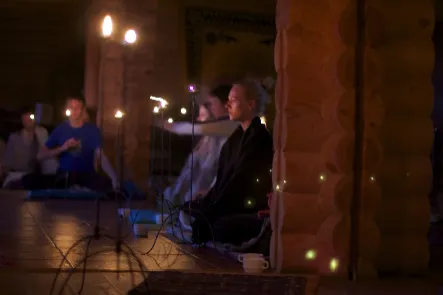
Diwali Festival
November 8, 2026
Mai Ram Yoga Ashram
Diwali Celebration – The Victory of Light Over Darkness
Diwali is an autumn festival of lights that symbolizes the victory of good over evil. People light candles and focus on inner light, unity, and joy.
Light holds a special symbolic meaning in the yoga tradition—it symbolizes knowledge, truth, and spiritual awakening.
The Diwali celebration is the most beautiful festival of light, marking the triumph of light over darkness, good over evil, and knowledge over ignorance. It is full of joy, as Diwali reminds us that the inner light is always present within us.
On November 8 (Sunday) at 5:00 PM, Diwali, the festival of lights, will take place at the ashram!
We invite all ashram visitors with their family and friends to participate in the celebration!
During the celebration, there will be a satsang with Guru Mai Ram, we will build a yantra of Goddess Lakshmi, and we will meditate on the Lakshmi mantra.
When coming to the celebration, please dress in white clothes and bring a candle, fruits, and white, red, or yellow flowers for Goddess Lakshmi's yantra.
What is Diwali?
The Diwali festival is a festival of lights, also known as the festival of light, celebrated in autumn. This festival is a significant part of Indian tradition, during which people light candles and lamps to symbolize the victory of light over darkness. Diwali symbolism emphasizes the importance of goodness, knowledge, and awareness. Diwali is a time for fellowship, joy, and spiritual growth.
Diwali (Sanskrit: दीपावली dīpāvalī) dates back to ancient times and is arguably the most beautiful celebration of the year. It is celebrated in October or November, coinciding with the new moon—the beginning of a new lunar phase. The festival symbolizes new beginnings and spiritual growth.
The main meaning of Diwali is the victory of light over darkness. This festival is closely tied to Indian traditions, and one of the most important mythological stories of Diwali involves Lord Rama's victory over the demon Ravana and his return to his homeland, Ayodhya. His return is a symbol of victory over darkness and injustice. Rama is the embodiment of righteousness. Truth and light always return, even if darkness temporarily seems to reign over the world. Ayodhya is not only a city, but also a symbol of the heart. Rama's return means that a person consciously welcomes God within themselves once again.
Diwali has deep spiritual significance. It is a time when people focus on inner light, the importance of goodness, and awareness. The celebration fosters love and unity, while also reminding us that every person has an inner light that needs to be nurtured and shared with the world. Therefore, in the ashram and at home, people light candles that symbolize the victory of light, joy, and divine blessing. The festival symbolizes renewal—both personal and communal. This celebration is widely observed in India and throughout South Asia.
What does the Diwali celebration symbolize?
Diwali's symbolism is associated with the triumph of light over darkness. Rama's return signifies that when a person faithfully lives in dharma with love, courage, and humility, divinity returns into their life. Rama symbolizes the divine consciousness within people, and Ayodhya is the pure heart awaiting that return. Light always returns to where people await it with a pure heart.
Lighting candles, lamps, and fireworks during the festival represents not only physical light, but also higher awareness leading to spiritual enlightenment.
The symbolism of light reflects the struggle between good and evil, where light represents truth, knowledge, awareness, and goodness, while darkness represents ignorance, fear, delusion, and evil. Lit lamps and candles illuminate not only homes, but also serve as a reminder of the need to seek and nurture inner light and harmony. During this period, people reflect on their values, strengthen their faith in goodness, and share joy with others.
Thus, Diwali is not just a holiday, but an invitation to seek light in both the material and spiritual worlds, to nurture wisdom, and to spread goodness around us.
How is Diwali celebrated at the Mai Ram Yoga Ashram?
The Diwali festival at the Mai Ram Yoga Ashram is celebrated with reverence for the name of Ram, which signifies the One who grants peace, love, bliss, and liberation. During Diwali, many candles and lanterns are lit at the ashram, their light symbolizing the divine radiance of Ram. During the celebration, devotional hymns praising God are sung: "Shri Ram, Jai Ram, Jai Jai Ram!" Homage is also paid to the Lord and Goddess Lakshmi. The name of Ram is considered very powerful, so its sincere repetition during the festival helps overcome all obstacles veiling the inner light.
The celebration represents light, spiritual growth, awareness, divine blessing, and other radiant values that not only a yogi, but every person must cultivate. Diwali is dedicated to emphasizing and establishing these qualities, rejoicing in them, and celebrating them. Thus, people gather at the ashram to celebrate and praise the divine light and radiance. At the end of the evening, as another expression of the symbol of light, floating lanterns/boats are set adrift on the river, marking the culmination of the celebration.
Mai Ram Yoga Ashram
Augustijonų g. 2, Vilnius, Lithuania tel.: +370 640 416 69
info@mairamyoga.lt


Mai Ram Yoga Ashram
Augustijonų g. 2, Vilnius, Lithuania tel.: +370 640 416 69
info@mairamyoga.lt
Mai Ram Yoga Ashram
Augustijonų g. 2, Vilnius, Lithuania tel.: +370 640 416 69
info@mairamyoga.lt